Building an AI-Native Organization: Process, Technology, People
Adoption is easy to count. Compounding is what matters. The three-pillar framework I use for AI transformation - and why investing in just one pillar produces a pilot that plateaus.
July 9, 2026
“How much AI are we using?” is the easiest question in the building to answer. Seat counts, token dashboards, adoption curves. Every organization has these numbers now.
Then the bills start piling up. Token costs grow quarter over quarter. And every operator eventually arrives at the harder question: is any of this actually making us more productive?
That question turns out to be genuinely difficult. Productivity in an organization is the sum of thousands of small decisions, handoffs, and workflows happening at once. Attribution is murky. The team that adopted AI heavily might be shipping faster because of AI, or because of a strong quarter, or because their best engineer finally got out of meetings. Nobody can cleanly isolate the variable.
So here is where I land after spending the past years working on this problem from the inside: if you are chasing scattered productivity gains, a few percent here and there, you do not need a framework. Buy the tools, let teams experiment, take the wins.
But if you are building an AI-native organization, one where AI is part of how decisions get made and how work compounds, then the framework matters a lot. Because the failure mode is always the same: investing in one dimension and wondering why nothing durable came out of it.
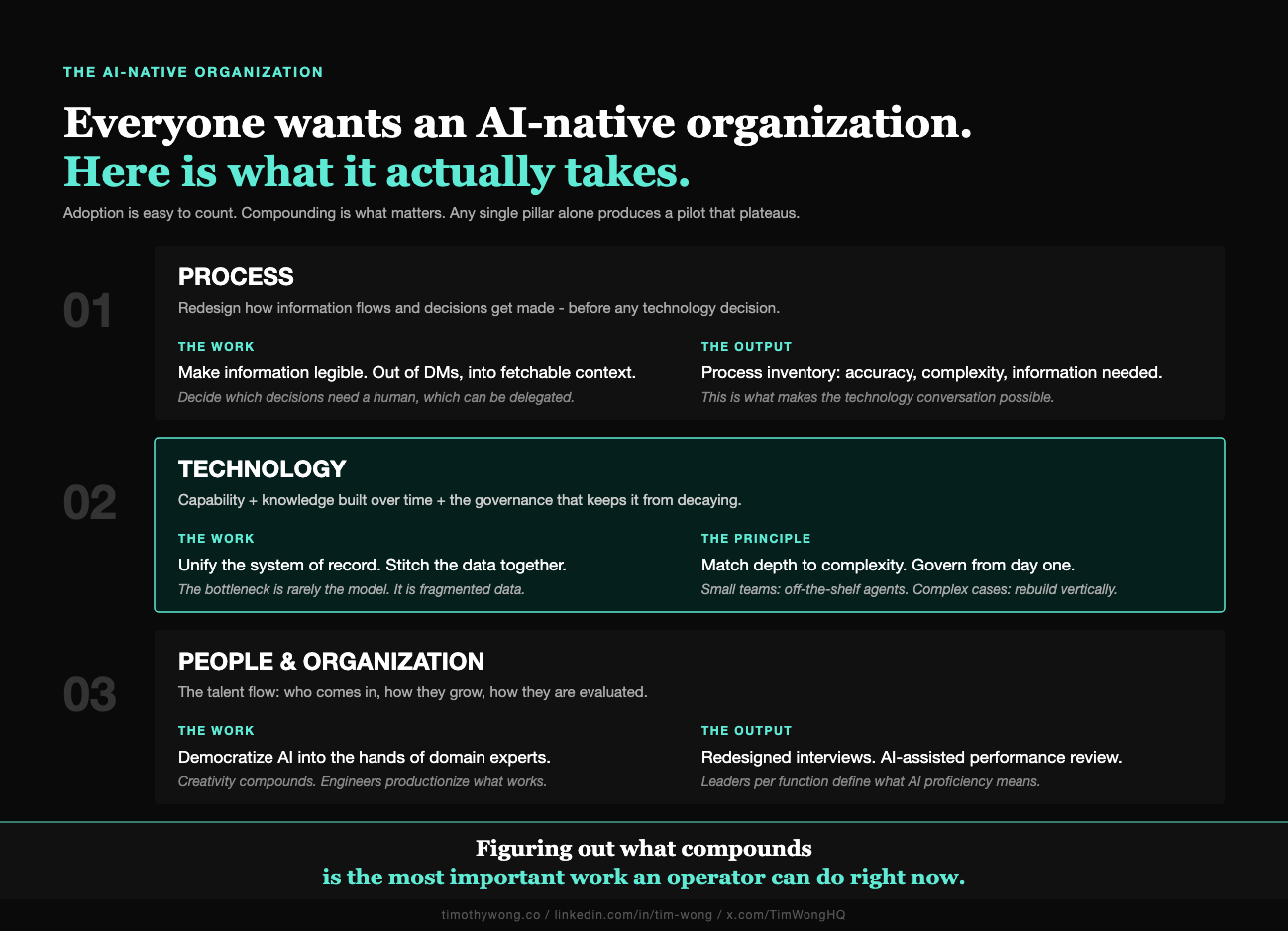
The framework has three pillars: Process, Technology, and People.
Pillar 1: Process
Before any technology decision, the organization has to redesign how information flows and how decisions get made.
Here is a concrete example. Some companies are deliberately moving away from direct messages toward public channels, so that the information AI needs to assist with decision-making actually exists somewhere fetchable. That is a process decision, not a technology one. If your organization’s context lives in DMs, meeting rooms, and people’s heads, no model can help you with it. The work of making information legible has to come first.
The same applies to decision-making itself. Which decisions need a human? Which can be assisted? Which can be delegated entirely? Most organizations have never written this down, because until now there was no reason to. Now there is.
The output of this pillar should be an inventory: your recurring processes, broken down by three dimensions - the accuracy each one requires, the complexity involved, and the information it needs to run. That inventory is what makes the technology conversation possible. Without it, you are buying tools for problems you have not defined.
Pillar 2: Technology
Technology is more than which tools you buy. I think about it as three things together: the capability itself, the knowledge that builds up over time, and the governance that keeps it from decaying.
The governance point comes from experience. In the data world, we have all seen it: something gets built once, it works, and two years later it is unusable again because nobody governed it. Pipelines nobody owns. Dashboards nobody trusts. Definitions that drifted. AI systems will rot exactly the same way without governance - except faster, because they generate more, and the interesting twist is that AI can also do much of the governance work itself. Generating documentation, flagging drift, testing consistency. This should be designed in from the start, not patched in later.
On capability, the honest answer is that the right depth depends on the size and complexity of your organization. For smaller companies, launching Codex or Claude Code across the team covers most use cases - you do not need to build anything. For more sophisticated cases, it may mean vertically rebuilding a system around the workflow. There is no single right answer, and anyone selling one is selling their product.
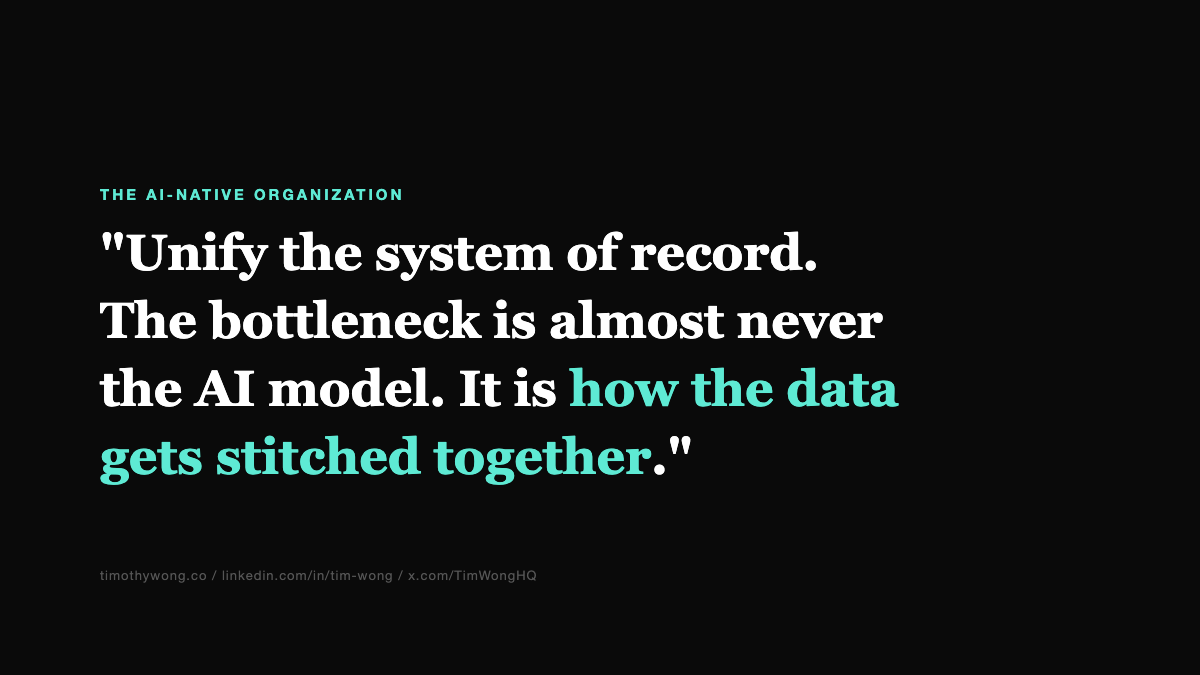
But whatever the depth, one principle holds: unify the system of record as much as you possibly can. In practice, the bottleneck is almost never the AI model. It is how people document and store their work, and whether the technology can stitch that data together into something useful. A mediocre model over unified, well-governed data beats a frontier model over fragmented data every time. This is the most important problem in the pillar, and it is the least glamorous one.
Pillar 3: People and Organization
I think about this pillar as a flow: people coming in, people growing inside, and how we evaluate along the way.
Coming in: recruiting has to change. We should be redesigning the interview process to evaluate the traits that matter now - how a candidate works with AI, how they decompose problems, whether they know what a correct result looks like in their domain. The old rubrics test for skills the tools have absorbed.
Growing inside: the single most important learning I have had over the past year is that you have to democratize AI into the hands of domain experts. Not centralize it in an AI team. Once domain experts can build with these tools directly, creativity compounds - they know what a correct answer looks like, they know where the real problems are, and they iterate at a pace no centralized team can match. Engineers then shift to what they are uniquely good at: taking what works and making it production-grade. This requires leaders in every function who can define what AI proficiency means for their teams - it is not one training program, it is one per discipline.
And evaluating: performance review itself should use AI. Not as a gimmick, but because evaluating talent fairly across a large organization is exactly the kind of high-volume, context-heavy judgment work that AI assistance genuinely improves. If we trust these tools to help us make product decisions, we should be building the same rigor into how we evaluate our people.
Why all three together
Anyone who lived through the automation era already knows the answer. Automation driven from the technology side alone never worked. The successful automations were the ones where the process was redesigned first and the people who ran the process owned the change.
AI is the same pattern at much higher stakes. An AI-native organization is not defined by which tools it bought. It is an organization that has redefined how decisions get made day to day, how people do their work, and how each piece of work compounds into the next - with AI woven through all three. That takes process, technology, and people together. Any one of them alone produces a pilot that plateaus.
Figuring out what compounds is the most important work an operator can do right now. The organizations that will still matter in five years are the ones asking that question across all three pillars. The ones counting seats are measuring the easy thing and calling it strategy.